Artane Partners
×
Saint Beaumont Creative
Elite Video Editor — VSL & Short-Form
We're an agency, but we don't outsource to freelancers and take a cut, every editor is in-house, so work doesn't depend on one person's availability.
NationGraph is one of our ongoing clients: this episode is one entry in a running series we produce for them. They originally planned to hire in-house, chose us instead, and have since renewed for a full year.
Coinbase — DFlow Integration
Edited from raw interview footage: structured the narrative, paced the cuts against Coinbase's head of on-chain trading, and integrated on-screen data callouts to keep a technical product story clear without losing precision.
DAWN — Black Box Launch
Edited from launch-day footage and founder interviews into a single brand film for DAWN's Black Box hardware launch, paced to build toward the product reveal rather than front-load it.
Kraken — Alpaca × xStocks
Cut two distinct versions from the same raw event footage at the Four Seasons Hong Kong: a slower, atmospheric edit and a higher-energy alternate, giving the client real options for different distribution contexts, not just a shorter version of the same cut. This is the slow one.
For reference, our rate is $90/hour. A true rate per finished minute doesn't hold up honestly, a minute of straight cutdown and a minute of custom motion graphics can be five minutes of work or six hours.
Link to the single best corporate or finance film you have edited. What exactly did you do on it?
One of our clients sits on a huge body of government data, covering over a hundred thousand public agencies. They came to us wanting to tell news stories with it, using the data to back up the reporting rather than lead with the product.
We helped shape the format from the start: a five to ten minute essay film built for YouTube, in the lane of Vox, Johnny Harris and Wendover, with the client's own team member on camera. We wrote the script and the shoot briefs, then flew to the US and shot it with a two-camera crew, on foot at a live construction site and in a studio. We directed the on-camera talent throughout to get the strongest performance we could.
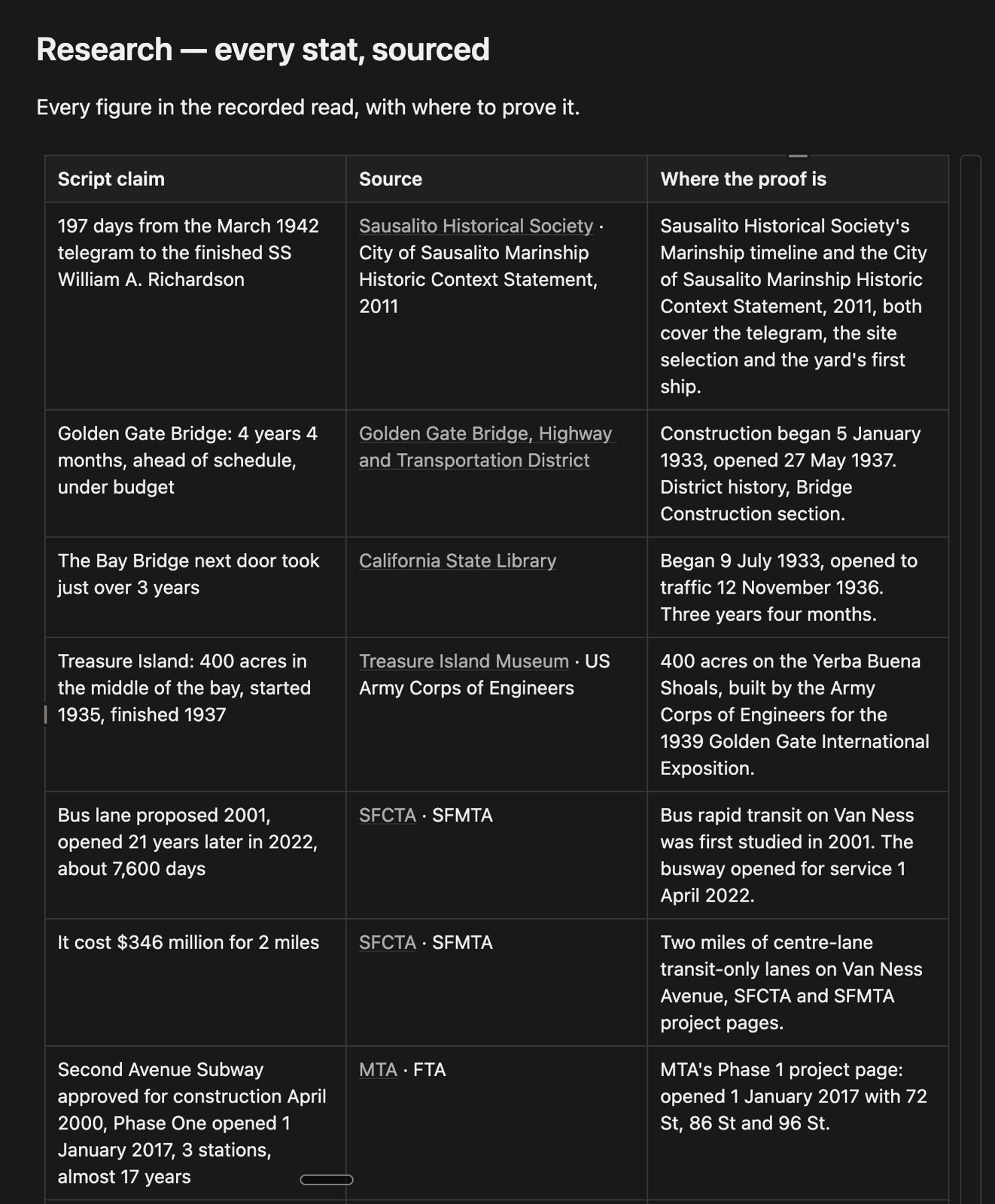
Before a frame was cut, the whole film existed on paper. We built a two-column script and visuals document with archival footage previewed as looping clips so the client could watch the film in their head and sign it off. Alongside it sat a research table with a primary source for every figure spoken on camera.
"America used to build things fast. The Empire State Building. The Pentagon. The Alaska Highway. The Berlin Airlift. The P-80 Shooting Star. The Boeing 747. You get the picture. Each of these went from start to finish in less than a year."
"But my favorite example actually started with a telegram. In March of 1942, the Maritime Commission wired the Bechtel Company and asked it to build a shipyard so America could deliver more supplies to the front lines. They picked the site the next day. 197 days after that telegram, the SS William A. Richardson was finished."
After the shoot we wrote a highly detailed editor brief for a colleague: a 25-shot archival pull list with the archive and rights status on every line, a locked motion style stated once, guardrails, and a who-does-what pipeline. Then we began the edit.
The look is real material, not stock. Where a line needed a visual we went to the archives: Library of Congress photographs of a Liberty ship being built in 1943, Corps of Engineers records, an 1880 railroad land grant map, mid-century USGS survey sheets.
"But there was another side to that speed. That land was not empty. Much of it was considered public domain because the federal government had already taken control of it, through treaties and force, from the people who lived there. That was the real cost here, and it was a lot lower back then." Three archival options were pulled for this line, one made the cut, this is that one. The other two slots below show the same research pull applied elsewhere in the film.
The finished film was delivered in 72 hours from camera rolling, just over ten minutes long with animated subtitles, including several custom motion graphics, kept simple by design as we were optimising for speed.
We'd point to this one first because it shows the whole of how we work in a single piece. The brief and the research show how much we care about detail. The turnaround shows we can bring a producer's discipline to creative work and still move fast. And the film itself shows the craft: the cinematography from the shoot, the edit, and some motion graphics, all done to a standard we'd put next to anyone's.
Every figure spoken in the recorded read was tracked against a primary source before it went in the script, this is a section of that table.
Describe how you would build a 4-second animated logo ident in After Effects from a vector file.
The way we'd approach this is to get the vector file properly prepped before even opening After Effects, that's where most of the time gets lost otherwise.
We'd open it in Illustrator and split the logo out into its separate parts, so the mark on one layer, the wordmark on another, and anything else like a strapline or a dot on its own. Outline all the type, name the layers properly and save that out as a clean AI file.
Then in AE we'd set up the comp at whatever the delivery spec is (usually 1920x1080 at 25fps, but it depends where it's going) with a 4-second duration plus a bit of handle either side. Import the AI file as a comp with layer sizes retained, then convert the layers to shape layers so we can animate the actual paths and strokes rather than just moving a picture of the logo around. Anchor points get set first too, scaling from the wrong point wastes more time than almost anything else in this process.
For the animation itself, keep it simple. The mark comes in first, either a stroke draw-on or a masked wipe over the first second or so, then the wordmark lands underneath with a slight overshoot, then hold.
The hold is the part people get wrong. You need a good second and a half where nothing is moving so the logo actually registers. Two or three animated properties per layer, maximum, and everything through the graph editor so nothing moves linearly, that's where most of the difference between a good ident and an average one comes from.
The last stage is the polish: a subtle scale-down on the hold, motion blur on, and colours checked against the brand guide. Sound design happens after the animation is locked, and we'd treat it as a standard part of the job, not an optional extra, a logo sting genuinely looks better with sound than without it. The one exception is when speed is the actual priority and the final delivery has no audio at all, in that case there's nothing to design sound for.
We'd render a ProRes 4444 with alpha as the master so it can sit over anything, and keep the project modular so a 9:16 or 1:1 version later is a quick turn, not a rebuild.
Which stock footage and music libraries do you hold commercial licences for?
Artlist, for both licensed B-roll and music.
What is your realistic turnaround for an 8-minute VSL from 4K multicam rushes?
48 hours for an 8-minute VSL if it's B-roll driven with no custom animation. Closer to a week if roughly 90 seconds of it carries custom motion graphics, built properly rather than rushed.
How many hours a week can you commit for the next six weeks?
This isn't one person's hours to divide up. We're a small in-house team, not freelancers stacking clients on the side, so a six-week engagement isn't limited by any single person's calendar, work moves to whoever on the team has capacity that week. Practically, that means we can commit the equivalent of a dedicated editor's full working week for the length of the project, without it depending on one person staying available for six straight weeks.